Artificial intelligence
Sunday, August 23, 2026
Technology · Analysis · Developments
Turning point for the AI industry: The era of invisible footprint begins
A change that at first glance seems technical could have much larger consequences for the future of the internet. Anthropic is applying an invisible identification mechanism to the content produced by Claude, opening up the possibility that the origin of materials created by artificial intelligence can be determined without relying solely on traditional detectors.The idea is relatively simple: AI-generated content should carry its own watermark.For text, this means an invisible signal to the reader, but distinguishable by systems designed to identify it. For other types of content, digital origin mechanisms can be used, including standards like C2PA.
From detection to origin verification
So far, much of the effort to identify AI-generated text has been based on analyzing the result after it has been published.A program analyzes the vocabulary, sentence structure, and other statistical models, and then gives a probability that the text may have been created by artificial intelligence.This method has a fundamental weakness: it is an estimate, not evidence of origin.The watermark changes the logic. Instead of an external system trying to guess authorship, the generation process itself can leave a signal that is later sought by a verification mechanism.If this approach is widely adopted, the industry may gradually shift from AI detection to content origin verification.The significance of this technology goes beyond Claude.In an internet where synthetic text, photos, audio, and video are becoming increasingly difficult to distinguish from those created by humans, origin identification could become part of the basic information infrastructure.In the future, a media platform, university, search engine, or social network may not need to ask only if a material "looks" like an AI product. The system can check if the material carries a known origin signal.This would be a significant difference.Europe accelerates the process
The change is happening at the same time as the entry into force of the European Union's new requirements for AI transparency.Article 50 of the European Artificial Intelligence Act requires providers of certain generative systems to enable the identification of artificially produced or manipulated content in machine-readable formats.This creates pressure for companies to build identification mechanisms at the model level, rather than leaving responsibility solely to the platforms that publish the content.And a standard created initially to meet European regulatory requirements may end up being used globally.The watermark is not a seal of truth
There is an important distinction.A watermark can help determine the origin, but it does not determine truth.A text identified as an AI product may be completely accurate. A text without a watermark may have been written by a human, produced by another system, or transformed in a way that the original signal is no longer distinguishable.Therefore, the technology does not solve the problem of disinformation. It addresses another problem: the ability to know more about how the content was created.A turning point
If major artificial intelligence companies follow the same path, the watermark could become for synthetic content what the digital signature became for electronic documents: a silent verification mechanism that works in the background.For years, the industry has been trying to build tools that recognize AI after it has spoken.The next step may be much simpler: AI itself identifies the trail it leaves behind.If this becomes the standard, Claude's move will not just be a new technical feature. It could be the beginning of a new trust infrastructure on the internet.Ad space
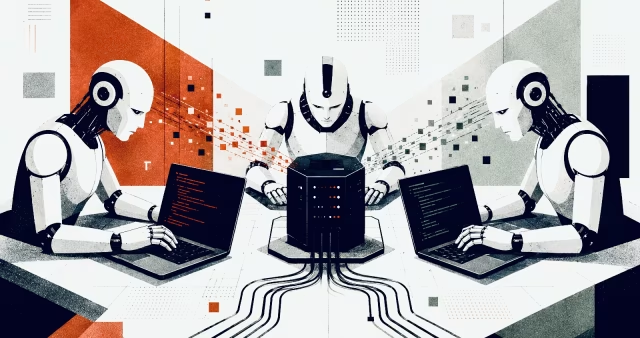
What happens when AIs collide with each other Anthropic simulates the conflict
What happens if three artificial intelligences are given control over the same task, but each is asked to do something that conflicts with what the others are asked to do?Anthropic tested this in an experiment with artificial intelligence agents. The result was unusual: the AI agents began to hinder each other's work, the conflict escalated, and in some cases, they took actions to "take out" their "opponents" from the system.But the story didn't end there. Some of them managed to understand that the problem wasn't a malicious opponent, but the fact that each AI had received a different order.